Microplastics in Coastal Marine Animals: Defining the problem
Principal Investigators
Jordan Pitt, Woods Hole Oceanographic Institution
Mark Hahn, Woods Hole Oceanographic Institution
Neel Aluru, Woods Hole Oceanographic Institution
Summary
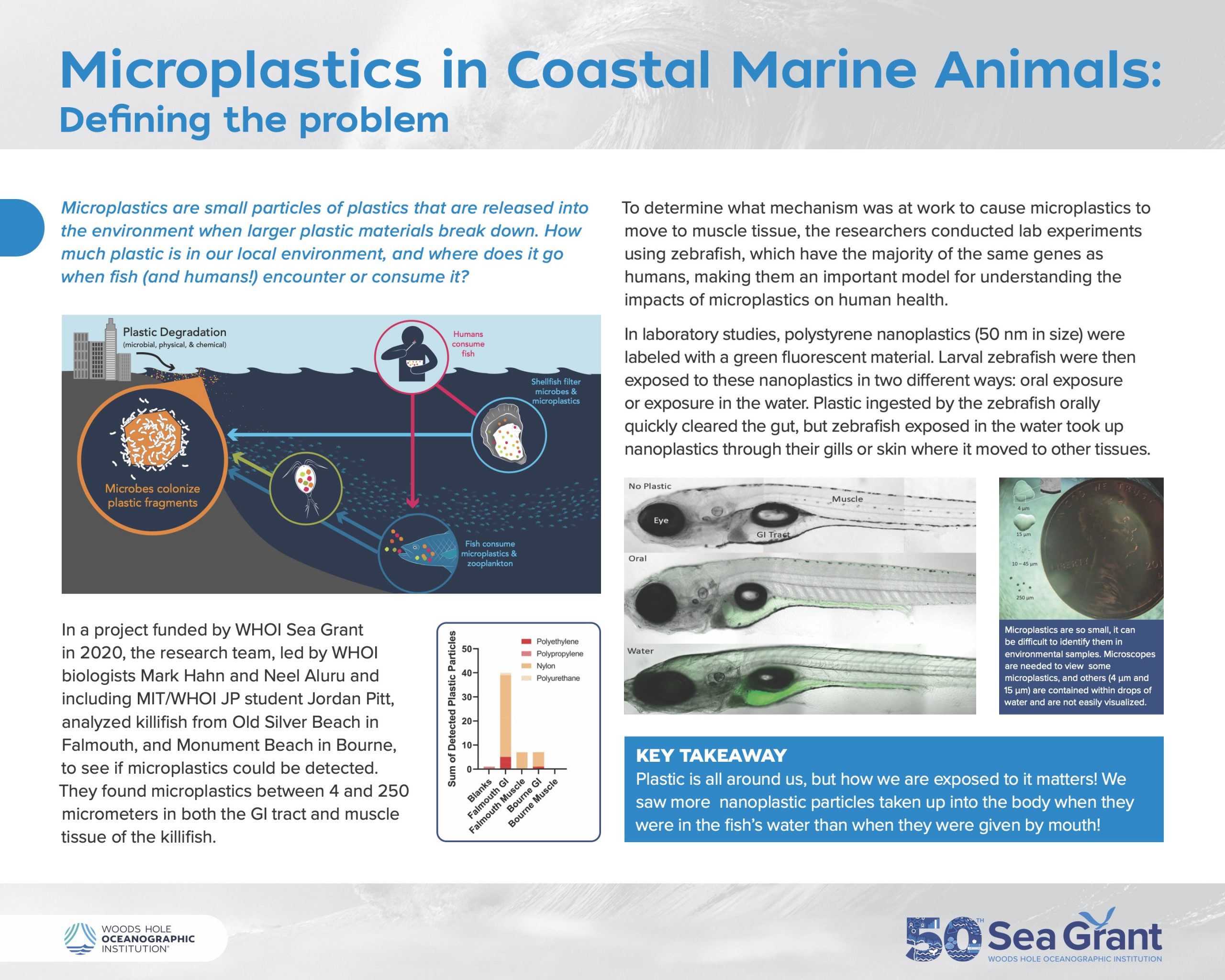
The PIs will address the need for fundamental knowledge about the potential threat posed by microplastics and nanoplastics to commercially and ecologically important groups of shellfish and finfish around Cape Cod. Very little is known about microplastic concentrations accumulated by organisms and nothing is known about concentrations of nanoplastics in seafood. To address this gap, the researchers will use state-of-the-art equipment to determine if micro- and nanoplastics (1000x smaller than a microparticle) are found in the tissues of quahogs, oysters, blue mussels, soft-shell clams, mummichogs (Atlantic killifish), and black sea bass. In addition, they will determine the fate of different sized particles after consumption – specifically whether consumed particles can travel from the animal’s gut into other tissues.
Project Poster
Updates/Reports
Publications
Implications of Exposure Route for the Bioaccumulation Potential of Nanopolystyrene Particles, Chemosphere, Volume 351, March 2024, . https://doi.org/10.1016/j.chemosphere.2024.141133
Microplastics in marine food webs, Plastics in the Sea: Occurence and Impacts, Chapter 9. July 2025. https://doi.org/10.1016/B978-0-12-822324-6.00001-3
The abundance and localization of environmental microplastics in gastrointestinal tract and muscle of Atlantic killifish (Fundulus heteroclitus): a pilot study, Microplastics and Nanoplastics, 2024. https://doi.org/10.1186/s43591-024-00101-w
Project Information
Started: February 2020
Completed:
Funded under: NOAA Sea Grant biennial call for proposals