
Post 10: Summer Drifter Recovery and First Year Summary
It’s been just about a month since we released our last three drifters on 7/20! All of the drifters started heading north immediately and, within two days, had exited Cape Cod Bay. Once out of the bay, two of the drifters (the Sophia and the Annie/Autumn) continued traveling north and eventually southeast and are still drifting in the Atlantic. It's fun and interesting to track where the drifters go, but, for the purposes of this study, we are most concerned with how long the drifters remain in the bay. We turned off their transmitters on Aug. 12 when they were approximately 75 miles and 50 miles offshore of Cape Cod.
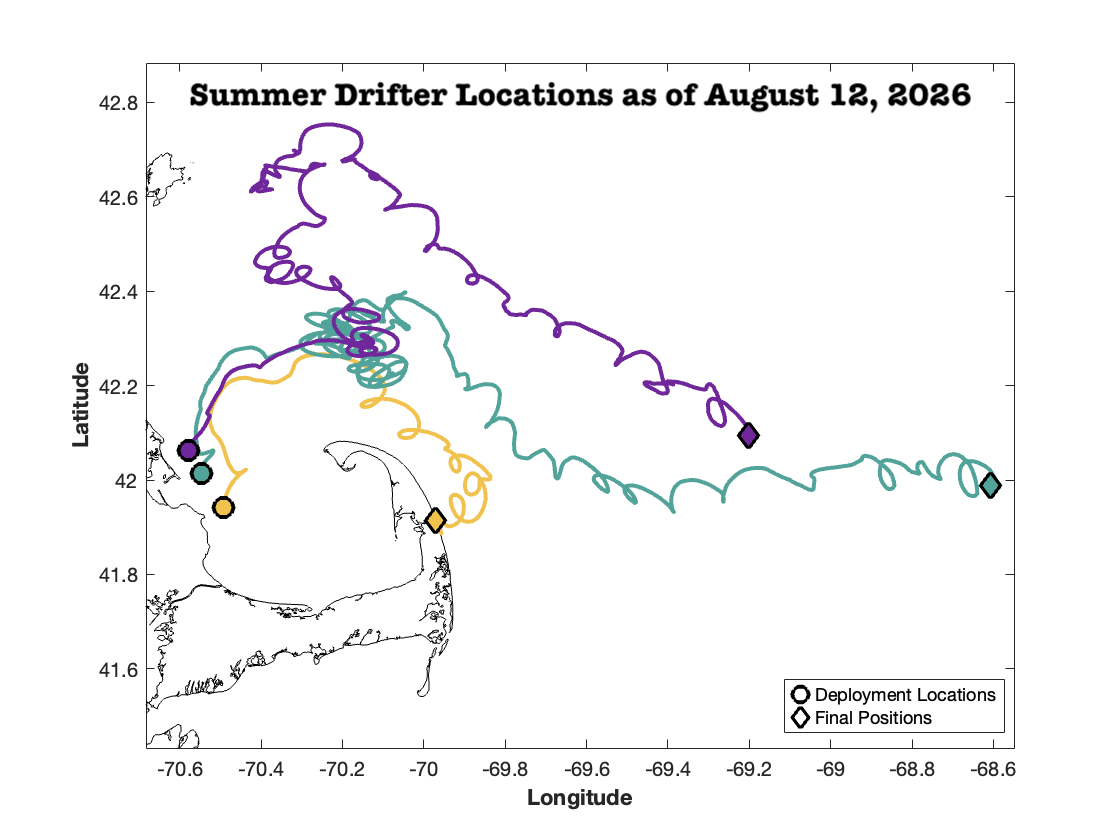
First Recovery: July 27
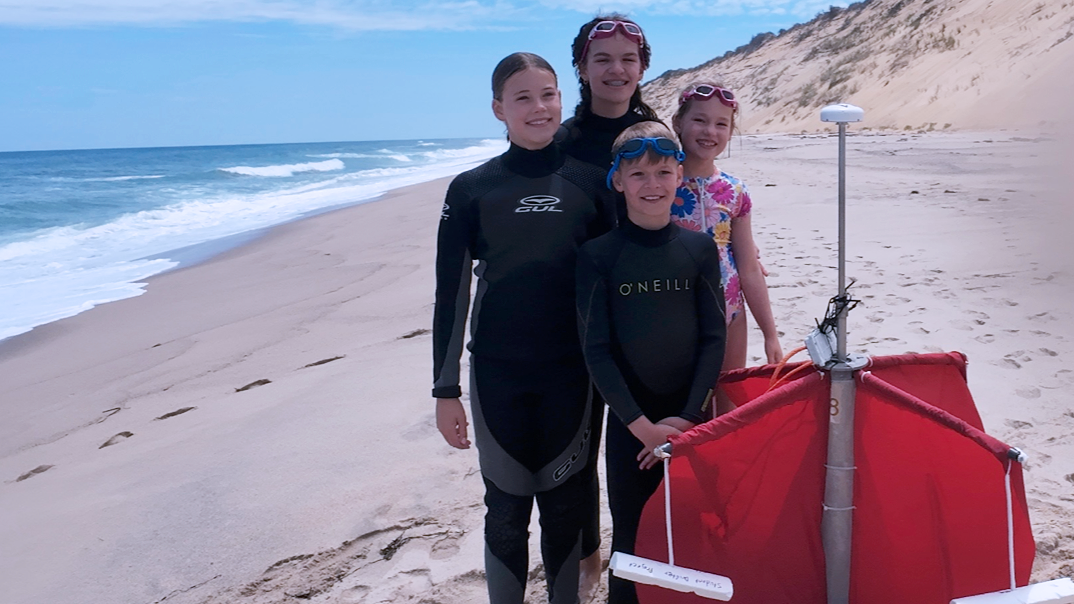
On July 27 around noon the Margaret drifter (#1) washed ashore along the Outer Cape! After exiting the bay, the drifter travelled south until it reached Wellfleet and was pushed towards the coast. The drifter landed along Lecount Hollow beach, where it was found by Janelle Krummel and her family who were on vacation. Luckily this beach is accessible by car, unlike the last drifter to end up along the Outer Cape, making this retrieval a lot easier!
Preliminary Results
We began this series of deployments last October. Now that we have completed a whole year of drifter releases, we have begun a broad analysis of the data. Comparing the pathways and time it takes each drifter to exit the bay suggests a seasonality in the transport out of Cape Cod bay. This is very exciting as it supports our previous numerical results! The figure below summarizes each release, grouping the drifter trajectories by season. In each plot, the black circles are the deployment locations, the diamonds are the final positions, and the colored circles denote the time it took each drifter to reach that location. The gray dashed line is used to define the bay’s northern boundary. Trajectories that travel beyond this line are deemed out of the bay, while trajectories south of the line are still in the bay.
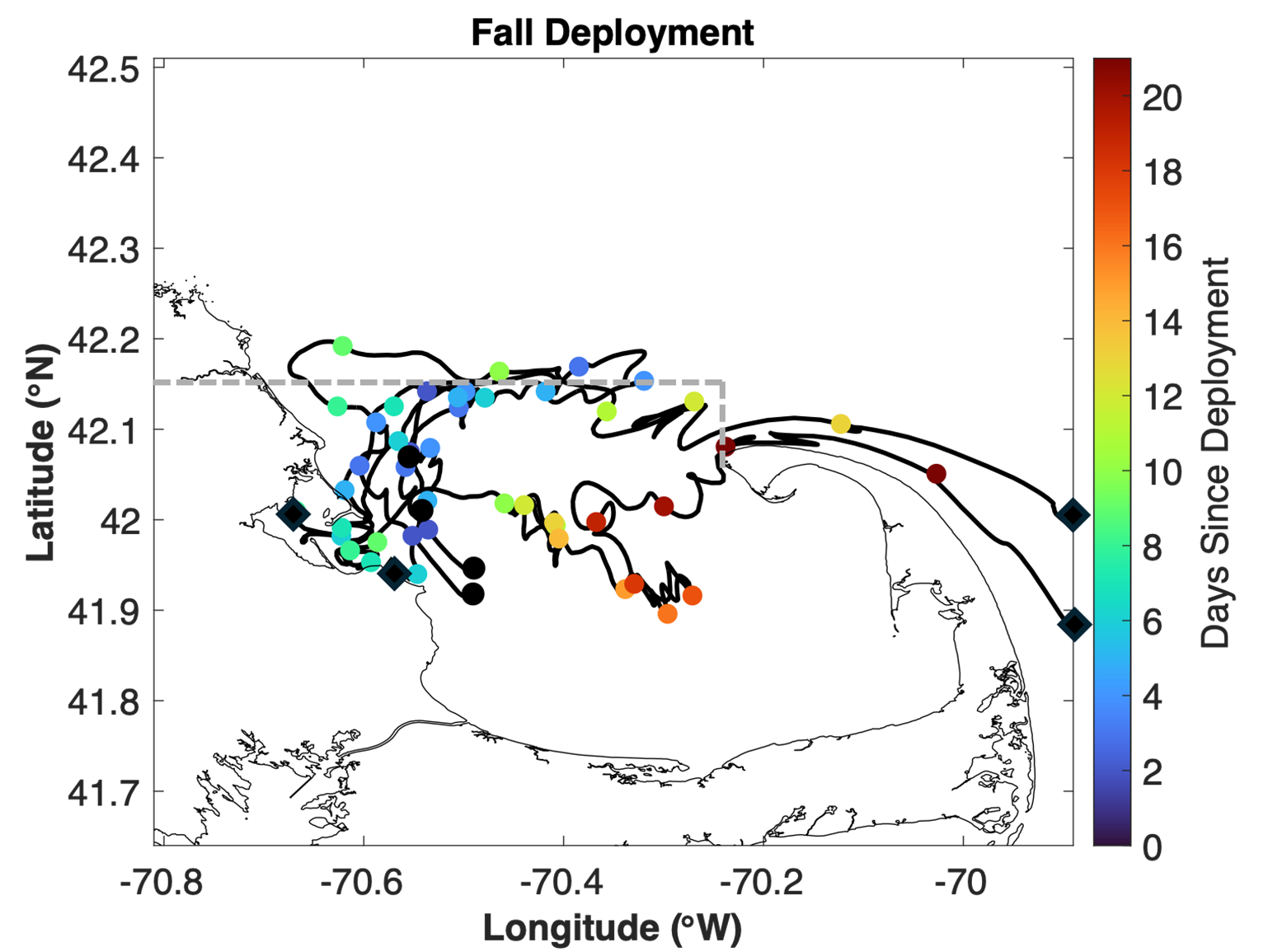
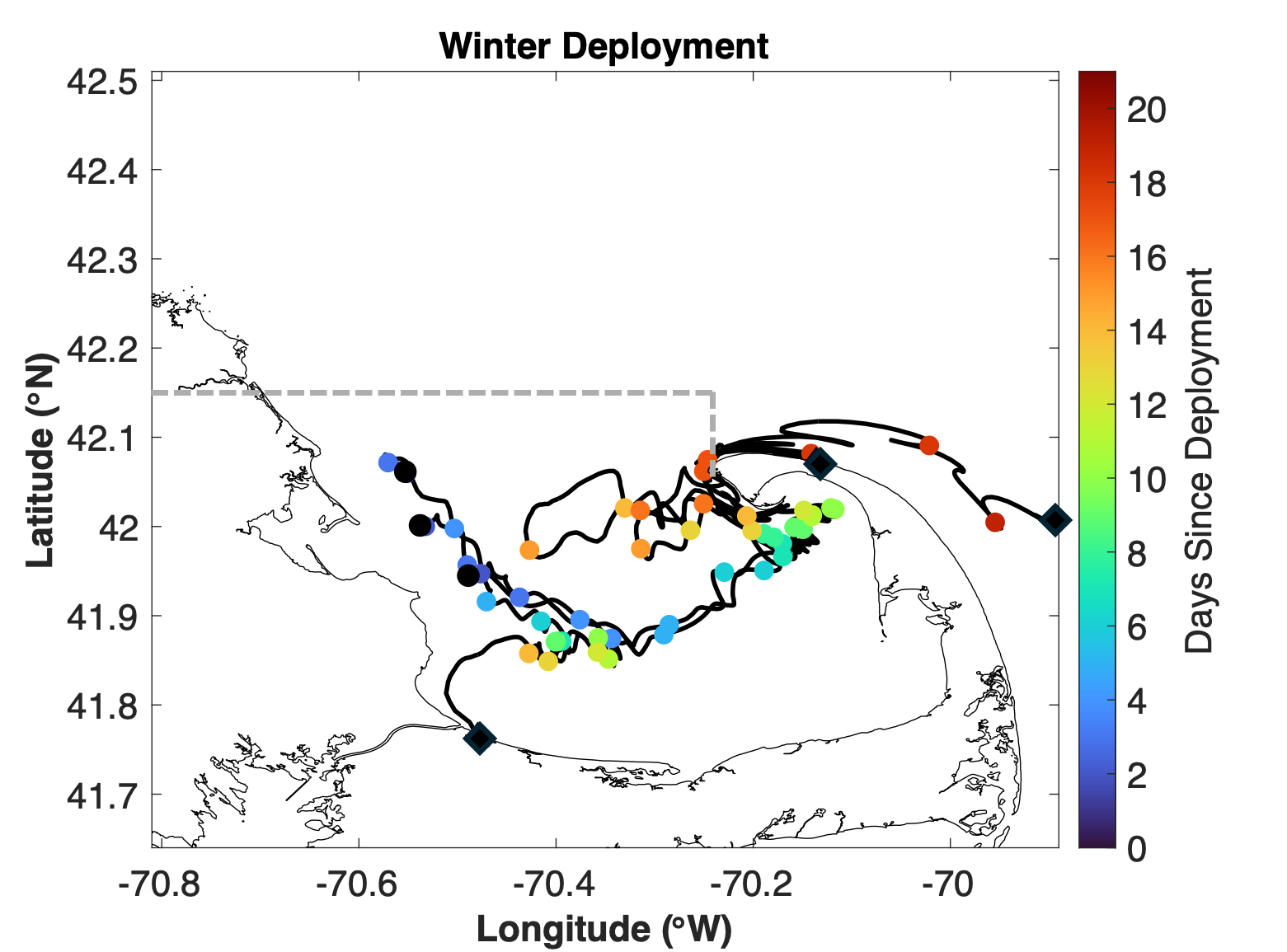
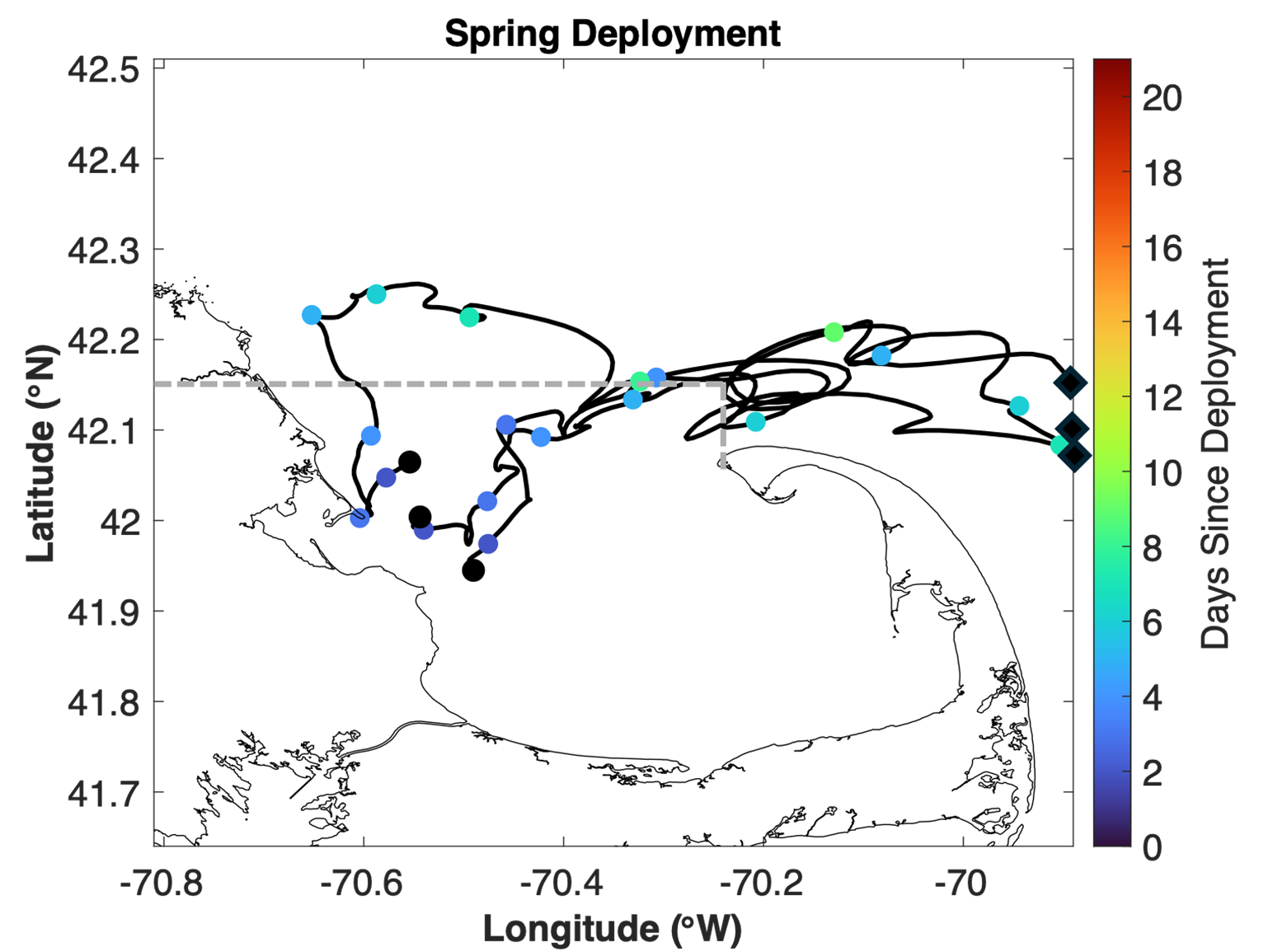
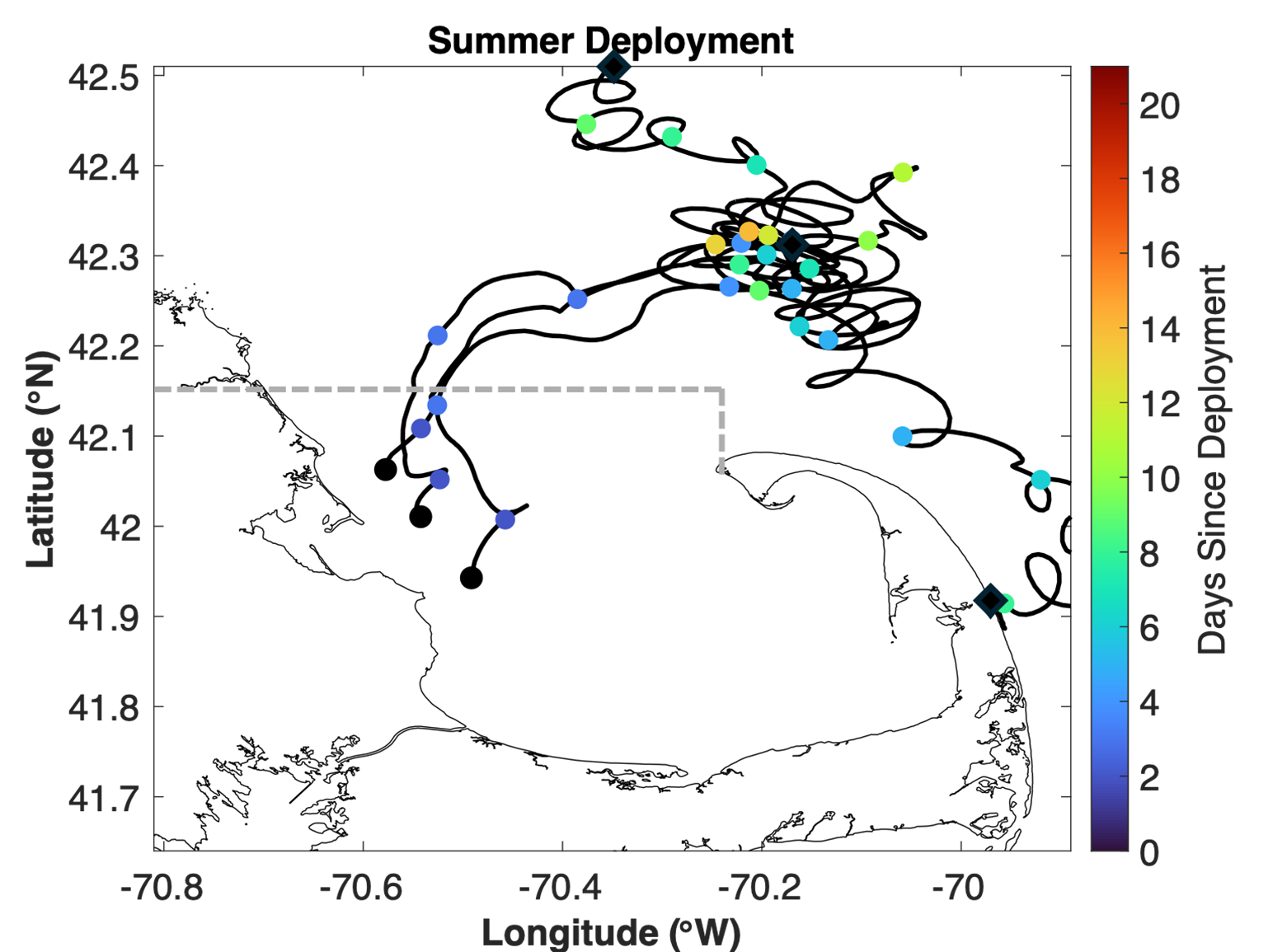
As you can see, drifters released during winter and fall have a greater probability of beaching within Cape Cod bay, and those that do exit spend more time (roughly 2 weeks) in the bay before leaving. On the other hand, all drifters deployed during spring and summer exited the bay in under five days, taking much more direct paths.
What's Next?
I am planning to carry out a further analysis of the data in the upcoming weeks, directly comparing the drifter paths and velocities to 2025 and 2026 data from a regional ocean model. Hopefully this comparison will allow us to identify processes and regions which are either well represented by the model or under-resolved, ultimately improving our interpretations of our numerical results.
It has been an interesting and exciting year deploying and tracking these drifters. A number of them are still adrift at sea, and who knows, maybe someday we’ll get a call from someone letting us know they found one. For now, this will be my last blog post for our first full year of drifter deployments. A huge thank you to everyone who made this project possible! Special shoutouts to the 2025 cohort of O-STEAM fellows who built the drifters, Grace Simpkins for organizing O-STEAM and helping with the releases, Stephanie Murphy for editing and posting the blog, and Peter Collins and the crew of RV Tioga for deploying the drifters. Finally, thank you, readers, for sharing this journey with us!
P.S. – If you are interested in continuing to follow this project, keep an eye out for our "sequel"! We'll be blogging about the 10 drifters built as part of the 2026 O-STEAM Fellowship and another year of seasonal releases, gathering more data to strengthen our understanding of the currents in Cape Cod Bay.