Search results for: Best%20Deals%201800-299-7264
Sea Grant Two if by Sea Vol. 9 No. 1 A joint n
Sea Grant Two if by Sea Vol. 9 No. 1 A joint n
Read MoreSand Transport by Unbroken Water Waves Under Sheet Flow Conditions
Sand Transport by Unbroken Water Waves Under Sheet Flow Conditions Trowbridge, J. and D. Young Journal of Geophysical Research, Vol. 94, No. C8, pp. 10971-10991, 1989 WHOI-R-89-015
Read MoreECP-2000-06
ECP-2000-06
Read MoreSeasonal Climatology of Tidal Non-linearities in a Shallow Estuary
Seasonal Climatology of Tidal Non-linearities in a Shallow Estuary Aubrey, D.G. and C.T. Freidrichs In: Aubrey, D.G. and L. Weishar (eds.), Hydrodynamics and Sediment Dynamics of Tidal Inlets, Lecture Notes on Coastal and Estuarine Studies, Springer-Verlag New York, Inc., Vol. 29, pp. 103-124, 1988 WHOI-R-88-022
Read MoreChanging Coastal Levels of South America and the Caribbean Region from Tide-gauge Records
Changing Coastal Levels of South America and the Caribbean Region from Tide-gauge Records Aubrey, D.G., K.O. Emery, and E. Uchupi Tectonophysics, Vol. 154, pp. 269-284, 1988 WHOI-R-88-014
Read MoreNon-linear Tidal Distortion in Shallow Well-mixed Estuaries: A Synthesis
Non-linear Tidal Distortion in Shallow Well-mixed Estuaries: A Synthesis Freidrichs, C.T. and D.G. Aubrey Estuarine, Coastal and Shelf Science, Vol. 27, pp. 521-545, 1988 WHOI-R-88-018
Read MoreSeabed Materials
Seabed Materials Broadus, J.M. Science, Vol. 235, pp. 853-860, 1987 WHOI-R-87-004 A large catalog of materials has been proposed as potential seabed resources, and some seabed materials such as hydrocarbons and tin already contribute to the world’s economy. Scientific advances have increased our knowledge of other seabed prospects, but realization of their potential will be…
Read MoreMassachusetts Sea Grant Graduate Research Fellowship
Massachusetts Sea Grant Graduate Research Fellowship Fellowship period: September 1, 2024–August 31, 2026 Purpose The purpose of the Massachusetts Sea Grant Graduate Research Fellowship is to support exceptional prospective graduate students who are engaged in coastal and marine research that furthers the goals of the Woods Hole Oceanographic Institution Sea Grant (WHOISG) and Massachusetts…
Read MoreKnauss Fellow Profile: Amanda Dwyer
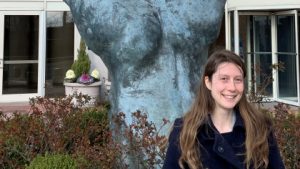
Amanda Dwyer, a 2020 Knauss Fellow, might not be having the typical fellowship experience, due to COVID-19 outbreak and the need to shelter in place, but she’s not letting that stop her work as a Marine Debris Program Specialist, focusing on a new zero waste initiative for National Ocean Service (NOS) offices. The zero waste…
Read More1990-2000 Fisheries & Aquaculture Overview
Snapshot WHOI Sea Grant’s investment in fisheries and aquaculture has resulted in the development of better management practices and policies for shellfish harvest and shellfish aquaculture and better understanding of the life history and environmental requirements of commercially important species of fish and shellfish. Background In Massachusetts, the fishing and aquaculture industries are tightly entwined…
Read More