Search results for: looking%20for%20cheap%20airline%20tickets%20to%20india%20phone%20number%201-800-299-7264
Cape Cod Towns Lead the Way on Sea Level Rise Planning
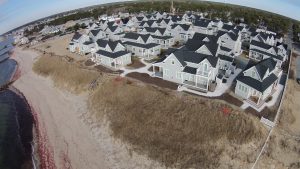
With help from WHOI Sea Grant’s floodplain specialist, three Cape Cod towns are pioneering new approaches to coastal flooding as sea level rise threatens to expand flood zones far beyond their current boundaries. Through a groundbreaking project in association with the Pleasant Bay Alliance, the towns of Orleans, Chatham, and Harwich are working to adopt…
Read MoreDGGE-based Detection Method for Quahog Parasite Unknown (QPX)
DGGE-based Detection Method for Quahog Parasite Unknown (QPX) Gast, R.J., E. Cushman, D.M. Moran, K.R. Uhlinger, D. Leavitt, and R. Smolowitz Diseases of Aquatic Organisms, Vol. 70, pp. 115-122, 2006 WHOI-R-06-003
Read MoreImpacts of Relative Sea-level Rise on Evolution of Shallow Estuaries
Impacts of Relative Sea-level Rise on Evolution of Shallow Estuaries Freidrichs, C.T., D.G. Aubrey, and P.E. Speer In: Cheng, R.T. (ed.), Residual Currents and Long-term Transport. Coastal and Estuarine Studies, Springer-Verlag New York, Inc., Vol. 38, pp. 105-122, 1990 WHOI-R-90-015 This study investigated the potential impact of sea-level rise by utilizing both one-dimensional numerical modeling…
Read MoreFrom Bike Shop to Bay: An intern’s journey into aquaculture
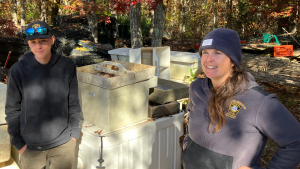
When Aydan Craveiro’s high school shop teacher sent an email about a job opportunity, he couldn’t have imagined where it would lead. The position — a shellfish aquaculture internship on Cape Cod — offered everything he was looking for: outdoor work, housing, and a chance to escape the basement of the bike shop where he’d…
Read MoreShrink Wrap Recycling Program
Boat Shrink Wrap Recycling Program WHOI Sea Grant partners with Cape Cod Cooperative Extension and transfers stations at towns across the Cape to recycle boat shrink wrap. Through this partnership we have identified a reliable recycler and a protocol for meeting the guidelines established to recycle this type of plastic. 2026 Collection Program for Residents…
Read MoreDecember Storm Damages Cape Coastline – Falmouth’s Surf Drive Takes Another Hit
December Storm Damages Cape Coastline – Falmouth’s Surf Drive Takes Another Hit Helpful to educators and students. Crago, T.I. and G.S. Giese Woods Hole Oceanographic Institution Sea Grant Program Marine Advisory Bulletin, No. 1, 2 pp., 1992 WHOI-G-93-001
Read MoreHistoric Shipwreck Management: Meeting of Experts II
Historic Shipwreck Management: Meeting of Experts II Hoagland, P. 51 pp., 1993, $3.00 WHOI-T-93-002
Read MorePreserving Our Homelands Camp Comes to WHOI
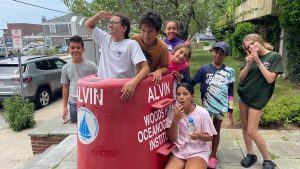
Most science educators will tell you, if you want to get kids excited about science, you have to actually do science. Last summer WHOI Sea Grant had the opportunity to participate in the annual “Preserving Our Homelands” Camp, an interactive summer scienc ecamp for Mashpee Wampanoag Tribal middle schoolers. The program aims to facilitate in the…
Read More2004-2006 Projects
Environmental Contaminants and Fish Reproduction Not if, but how? That is the question WHOI postdoctoral investigator Joanna Wilson is asking about how certain environmental contaminants effect marine and freshwater fish reproduction. By applying new research tools—advanced mass spectrometry and proteomics—Wilson and her former graduate advisor, John Stegeman, a WHOI senior scientist, will measure proteins associated…
Read MoreNew Woods Hole Sea Grant Website
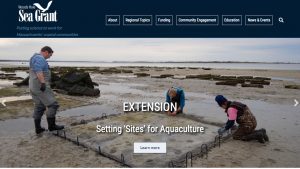
Woods Hole Sea Grant has a new look and a new URL — seagrant.whoi.edu. Take a few minutes to browse our new website and update your bookmarks. We’re eager for any feedback you might have. Email us at seagrant@whoi.edu.
Read More